Skip to the review
Phab Physics

AP Physics C: Mechanics · Unit 4 · No account needed

Interactive Unit Review: AP Physics C: Mechanics Unit 4

Linear Momentum

This review covers AP Physics C: Mechanics Unit 4 with the calculus the course requires. It starts at the launch site, where a crane lifts a 4.5 m boom whose linear density grows along its length. You find the boom’s mass and its center of mass by integration, and the boom hangs level only if the crane’s clamp is at the center of mass.

15 questions in 6 stages · progress saves in this browser

Start the review
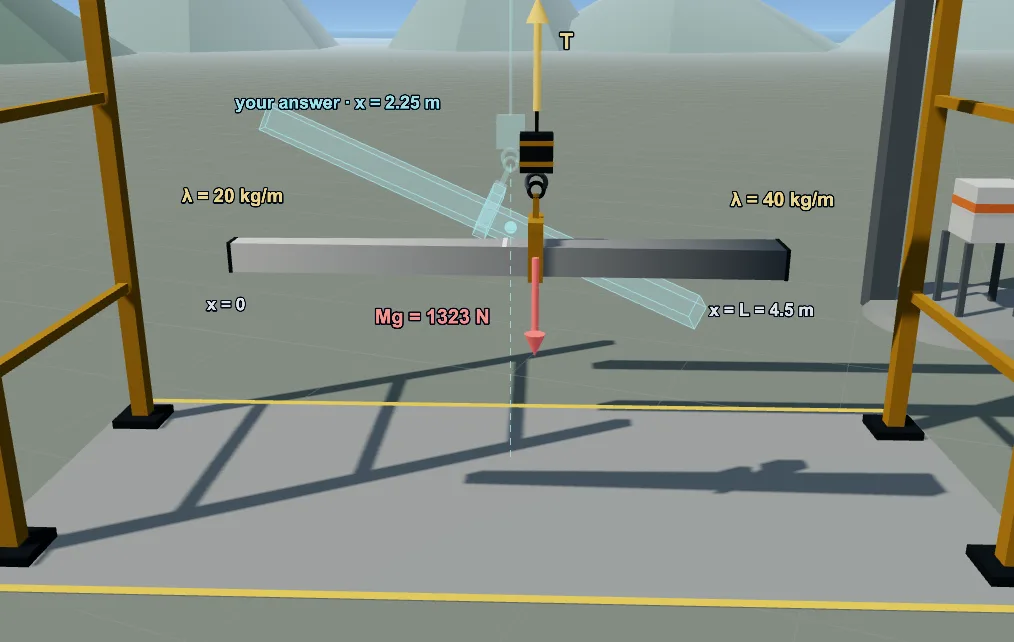
The crane boom stage: a boom whose density grows along its length hangs from a crane, and a ghost boom clamped at the student’s position tips toward its heavier end.
Crane boom · the boom hangs level only at its center of mass

How it works

Answer first, then watch your answer run.

In space, the thruster force is a function of time, F = (450 N/s²)t(2.0 s − t), so the impulse is an integral. The 40 kg cargo pod then docks with a cargo module, separates from it with a spring, rebounds from a bumper, and collides with a drifting crate. You use conservation of momentum, an energy bar chart and a momentum vector diagram, and a cyan ghost moves according to each answer beside the real objects.

  1. Answer the question. Each question asks for a number, a choice, a momentum vector diagram, or an energy bar chart. Hints and worked values are available when a step blocks you.
  2. Watch the stage run. The solid objects move according to the ideal solution, and the cyan ghost moves according to your answer.
  3. Read the feedback. Each common mistake gets its own explanation, and the final card lists the topics you missed on the first try.

What this review covers

6 stages from linear momentum.

Stage 1

Docking boom

  • Mass of a rod with varying density
  • Center of mass by integration

Stage 2

Thruster launch

  • Impulse as the integral of force over time
  • Impulse changes momentum

Stage 3

Docking

  • Momentum is conserved in a perfectly inelastic collision
  • Kinetic energy in a perfectly inelastic collision
  • Energy bar charts for a perfectly inelastic collision

Stage 4

Spring separation

  • Conservation of momentum when objects push apart
  • Energy stored in a spring (Unit 3 review)

Stage 5

Bumper rebound

  • Change in momentum is a vector
  • Average force from impulse
  • Padding and contact time

Stage 6

Glancing collision

  • Momentum is a vector
  • Speed after a two-dimensional collision
  • Direction after a two-dimensional collision

Inside the review

A wrong answer shows what it would do.

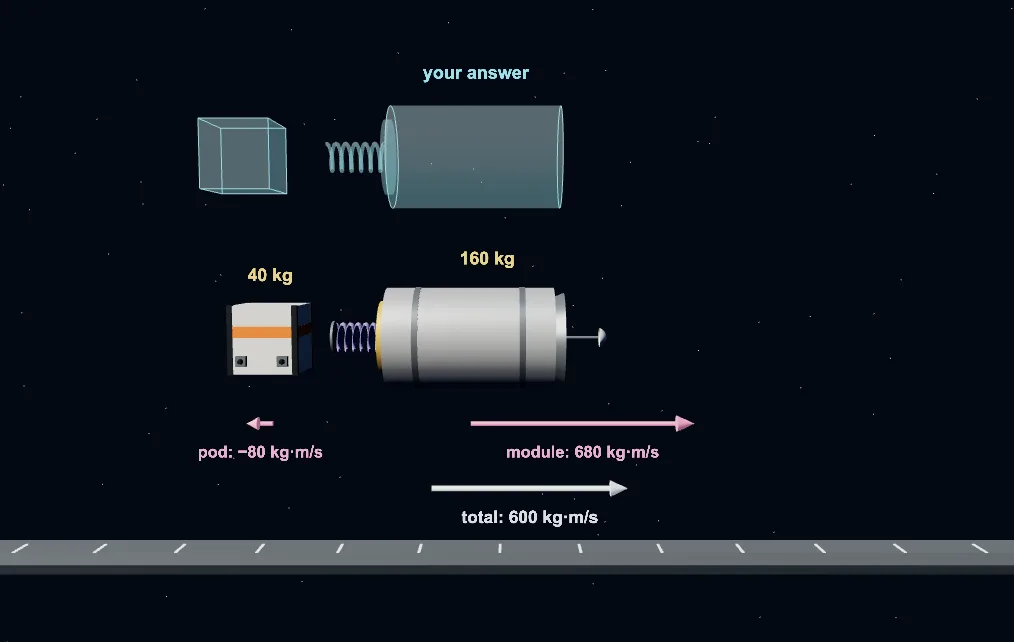
The spring separation stage: a ghost pod and module, pushed apart by a spring compressed too far, separate faster than the real pod and module.
Spring separation · the ghost separates with the energy your compression stores
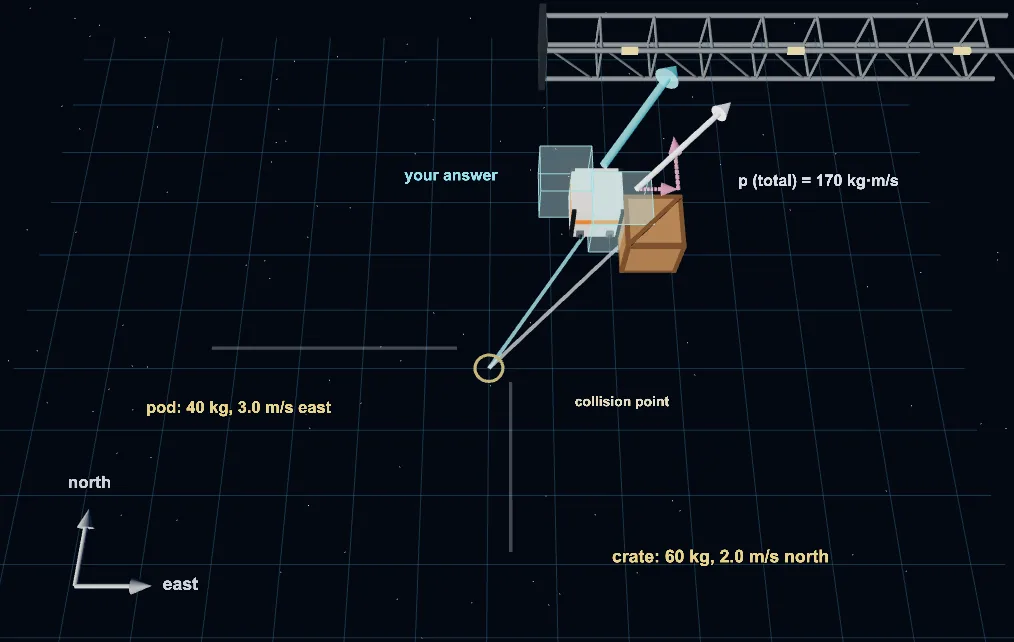
The glancing collision stage: after the pod and a crate stick together, a ghost wreck leaves at the wrong angle, north of the real wreck.
Glancing collision · the ghost leaves at the angle you enter

Start the review

For teachers

Share one link with your class.

Students do not need accounts. Progress saves in each student’s browser, so a class can finish the review over two periods, and the final card lists the topics each student missed on the first try. Results from this link are not sent to you.

In a Phab Physics class, this review is the Unit Mission at the end of Unit 4, alongside daily handouts, guided problems and practice with a class progress view. See the teacher guide.

More reviews

Other interactive unit reviews.