Skip to the review
Phab Physics

AP Physics C: Mechanics · Unit 3 · No account needed

Interactive Unit Review: AP Physics C: Mechanics Unit 3

Work, Energy, and Power

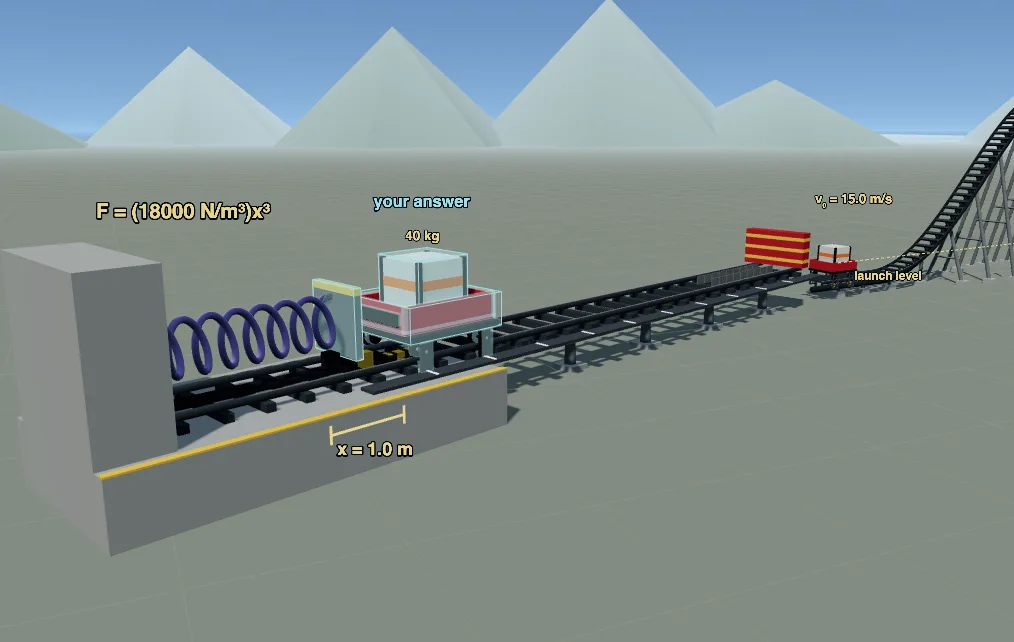
This review covers AP Physics C: Mechanics Unit 3 on a roller coaster, with the calculus the course requires. The launcher uses a stiffening spring whose force grows as the cube of its compression, so the stored energy is a work integral rather than ½kx².

16 questions in 6 stages · progress saves in this browser

Start the review
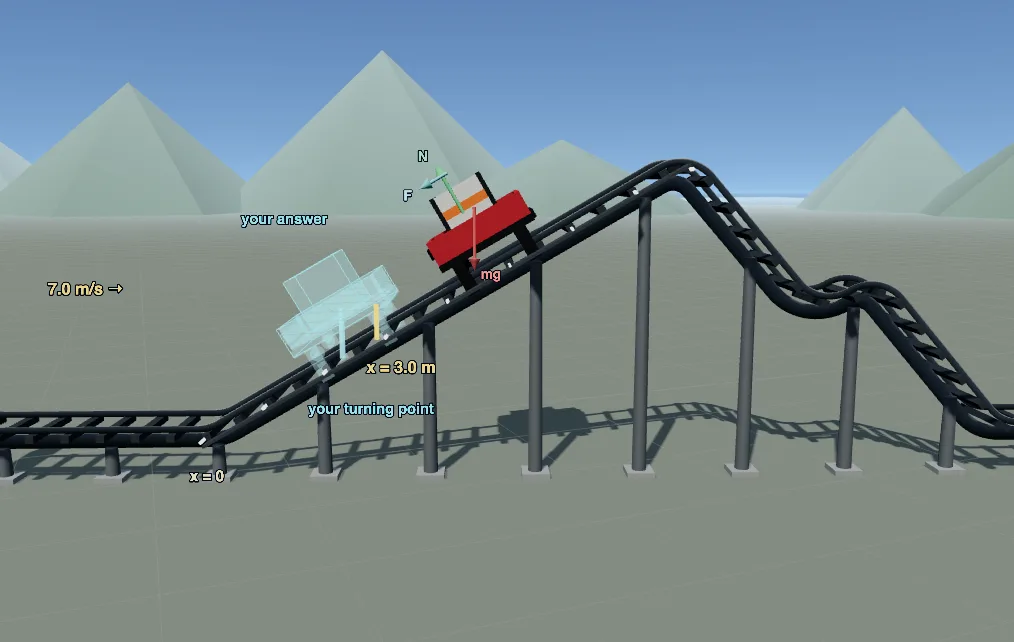
The camelback stage: the potential-energy graph and a ghost cart that turns back at the wrong position.
Camelback · force from the slope of U(x) and the turning point

How it works

Answer first, then watch your answer run.

A camelback section asks for the force on the cart from the slope of a potential-energy graph, F = −dU/dx, and for the turning point where the potential energy equals the total energy. You also draw energy bar charts, find a braking distance, and calculate the work and power of a chain lift. A cyan ghost cart moves according to each answer beside the real cart.

  1. Answer the question. Each question asks for a number, a choice, a free-body diagram, or an energy bar chart. Hints and worked values are available when a step blocks you.
  2. Watch the stage run. The solid objects move according to the ideal solution, and the cyan ghost moves according to your answer.
  3. Read the feedback. Each common mistake gets its own explanation, and the final card lists the topics you missed on the first try.

What this review covers

6 stages from work, energy, and power.

Stage 1

Spring launcher

  • Work done by a variable force (the work integral)
  • Spring potential energy becomes kinetic energy
  • Energy bar charts for a spring launch

Stage 2

First hill

  • Conservation of energy: speed at a height
  • Speed depends only on height

Stage 3

Loop

  • Conservation of energy in a vertical loop
  • Path independence of mechanical energy
  • Circular motion at the top of the loop (Unit 2 review)

Stage 4

Camelback hills

  • Force from the slope of a potential-energy graph
  • Turning points on a potential-energy graph

Stage 5

Brake run

  • Work done by friction stops the cart
  • Energy bar charts with friction

Stage 6

Lift hill

  • Free-body diagram on a lift hill
  • Work done by a constant force
  • The work-energy theorem at constant speed
  • Power delivered by a force

Inside the review

A wrong answer shows what it would do.

The stiffening-spring launcher, labeled F = (18000 N/m³)x³, after it has pushed the cart off its platform.
Stiffening spring · F = cx³, so the stored energy is a work integral
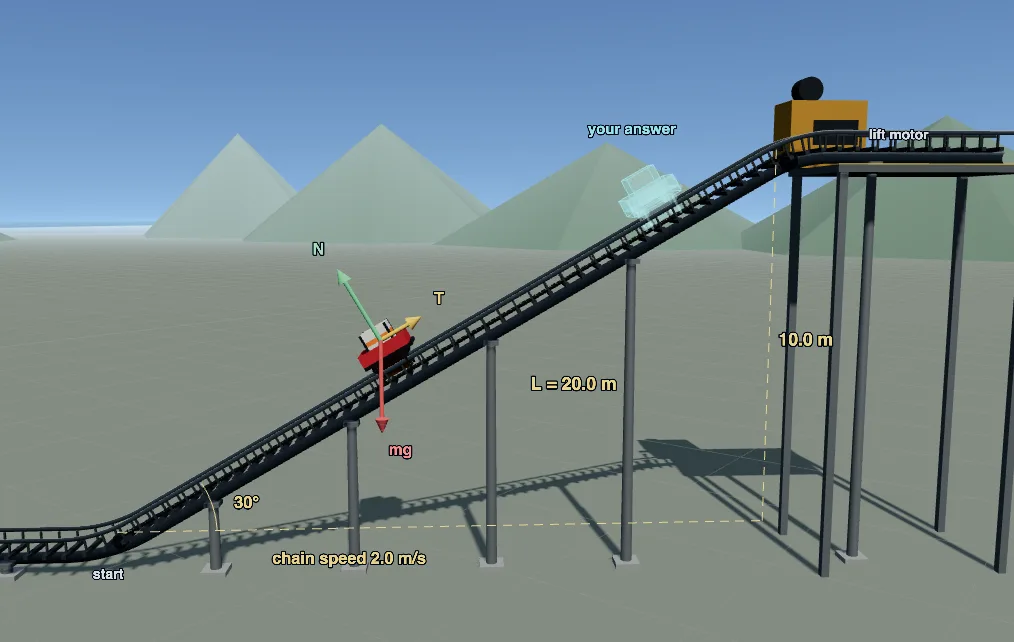
The lift hill stage: a chain pulls the cart up a 30 degree incline while a ghost cart climbs at the speed the student’s power implies.
Lift hill · the ghost climbs at the speed your power implies

Start the review

For teachers

Share one link with your class.

Students do not need accounts. Progress saves in each student’s browser, so a class can finish the review over two periods, and the final card lists the topics each student missed on the first try. Results from this link are not sent to you.

In a Phab Physics class, this review is the Unit Mission at the end of Unit 3, alongside daily handouts, guided problems and practice with a class progress view. See the teacher guide.

More reviews

Other interactive unit reviews.