Easy
Momentum of a rolling ball
A bowling ball of mass 4.00 kg rolls in a straight line at 4.00 m/s. Find the magnitude of its momentum.
Hint and worked answer
Multiply mass by speed.
p = mv = (4.00 kg)(4.00 m/s)
p = 16.0 kg·m/s
A sample teaching day · No account needed
Try the same sequence your students would use: a daily handout, a supported guided problem, then independent practice.
AP Physics 1 · Unit 4 · Day 1
Impulse & force–time graphs
01 · On paper
Use the day’s handout for the warm-up, notes, and paper practice. Students can sketch, calculate, and explain their reasoning before opening the guided problem.
Open the daily handout (PDF) ↗Opens in a new tab. Teacher keys are separate and require an approved teacher account.
02 · With support
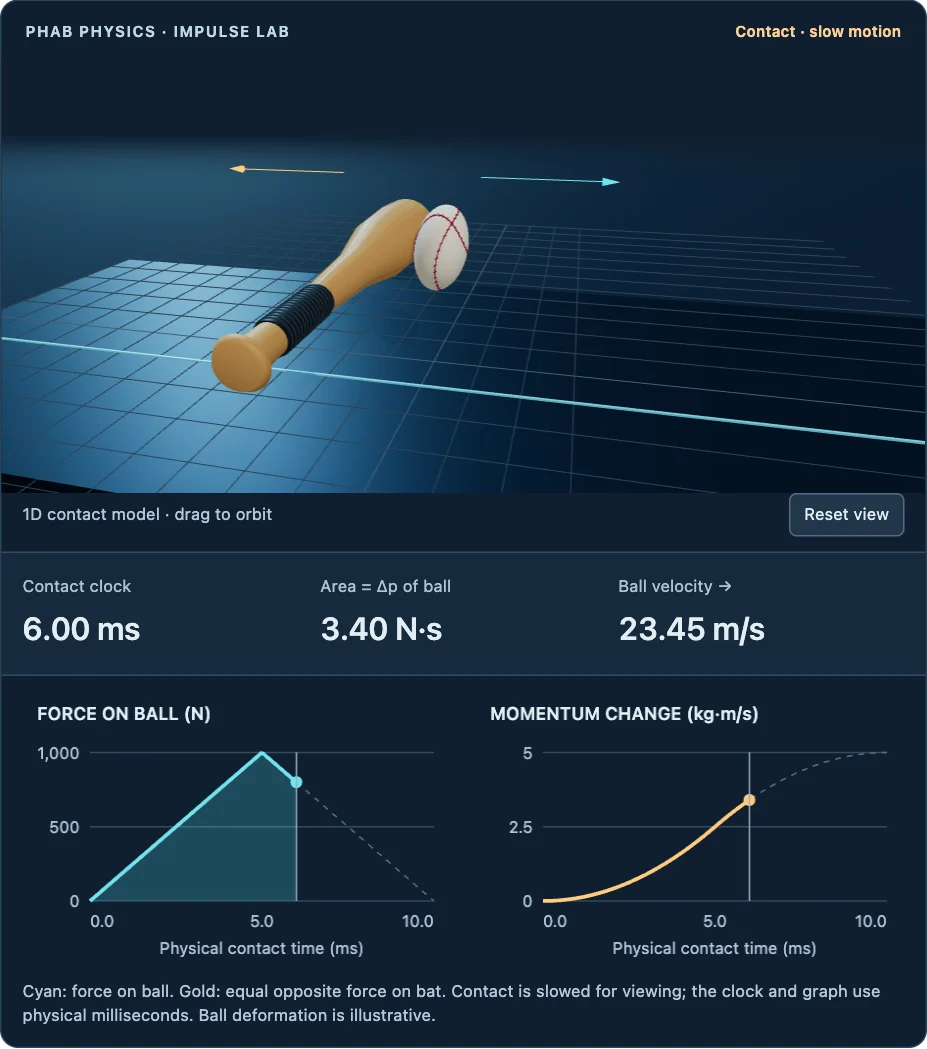
Watch the bat–ball contact, inspect the force graph, and connect its area to the ball’s change in momentum. Use the hints and worked values whenever a calculation blocks the next step.
This preview does not record classroom credit. Students doing assigned work should open Guided from their class’s lesson page.
03 · Independently
These fixed examples use problems from this day’s online practice. Work on paper, then open the worked answer. The full practice site generates new numbers and checks answers; these previews do not award points.
Teachers choose the daily goal and which levels to assign. Students do not have to complete every level in order.
Easy
A bowling ball of mass 4.00 kg rolls in a straight line at 4.00 m/s. Find the magnitude of its momentum.
Multiply mass by speed.
p = mv = (4.00 kg)(4.00 m/s)
p = 16.0 kg·m/s
Medium
A constant force of 100 N acts for 0.200 s. What impulse does that force deliver?
For a constant force, the force–time area is a rectangle.
J = F Δt = (100 N)(0.200 s)
J = 20.0 N·s
N·s and kg·m/s are equivalent units of impulse.
Hard
A 0.400 kg ball starts from rest. The net force in one direction rises linearly from zero to 200 N in 0.100 s. Find the ball’s final speed.
The force–time area is a triangle. Its area gives the net impulse; then use Jnet = m(vf − vi).
Jnet = ½(200 N)(0.100 s) = 10.0 N·s
vf = 0 + 10.0 / 0.400
vf = 25.0 m/s
Boss
A sled starts from rest. Its forward thrust increases linearly from 200 N to 500 N over 4.00 s. A constant 60.0 N friction force opposes its motion. A separate calibration found that a net force of 180 N produced an acceleration of 0.600 m/s². Find its speed after the thrust phase.
Use the calibration to find the mass. Subtract the friction impulse from the thrust impulse, then find the change in speed.
m = 180 / 0.600 = 300 kg
Jthrust = ½(200 + 500)(4.00) = 1400 N·s
Jfriction = −(60.0)(4.00) = −240 N·s
Jnet = 1160 N·s
vf = 1160 / 300 = 3.87 m/s
Open practice, choose Continue as Guest, then AP Physics 1 → Unit 4 → Day 1. For classroom credit, students instead sign in and use their teacher’s assigned day.
Open the practice site ↗The teacher guide shows class setup, student joining, daily goals, and progress tracking with screenshots. During the 2026–2027 pilot, a new teacher account requires a payment of at least $5 on Ko-fi. We suggest $3 per student. Alex then sends you a teacher code.
Before enrolling students, confirm your district’s approval and complete any required agreement with us. School privacy and accessibility review is ongoing. Read the current school-use status.
Create a teacher account or request a code →AP Physics 1 · AP Physics 2 · AP Physics C (Mechanics & E&M)